Starting a desert garden takes three things: the right plants (drought-tolerant natives adapted to your desert region), amended soil or a raised bed, and drip irrigation on a timer. Get those three right and the desert does the rest — rewarding you with a low-maintenance, water-wise garden that thrives where others struggle.
Welcome to the rewarding adventure of desert gardening! If you're looking around your dry, dusty yard and wondering, "Can anything even grow here?" — the answer is a resounding yes. Starting a desert garden from scratch may seem daunting at first, but with a few handy tips, the right tools, and some resilient plants, you'll turn your arid space into a thriving desert paradise.
Tools Every Desert Gardener Needs
Before you dig your first hole, make sure you have the right gear. Desert soil is often hard, rocky, and compacted — general-purpose tools won't always cut it.
- Quality Garden Gloves: Cacti spines, thorny shrubs, and rough soil call for thick, puncture-resistant gloves. Don't skip this one.
- Hand Trowel and Cultivator: For breaking up compacted soil and planting smaller specimens. Look for a trowel with a rust-resistant stainless steel blade.
- Long-Handled Shovel: Essential for planting trees, large shrubs, and breaking through caliche — the hard calcium carbonate layer common beneath desert soil surfaces.
Preparing Your Desert Soil
Amend Your Soil
Desert soil is typically alkaline (pH 7.5–8.5) and low in organic matter. For most native desert plants, minimal amendment is ideal — they evolved in lean soil, and enriching it too much can cause lush, unsustainable growth. For edible gardens and non-native plants, work in 3–4 inches of quality compost to the top 12 inches of soil before planting.
Mulching Matters
Mulch is one of the highest-impact investments you can make in a desert garden. A 3–4 inch layer of organic mulch (wood chips, shredded bark, or straw) around your plants will reduce soil temperature at the root zone by 10–20°F, dramatically slow moisture evaporation, and gradually improve soil structure as it breaks down. Keep mulch a few inches away from plant stems to prevent crown rot.
Choosing Desert-Friendly Plants
| Plant | Type | Water Needs | Why Start Here |
|---|---|---|---|
| Desert Museum Palo Verde | Tree | Very low | Fast shade, thornless, no seed pods |
| Desert Willow | Small tree | Very low | Blooms May–Sep, attracts hummingbirds |
| Prickly Pear | Cactus | None | Edible pads and fruit, indestructible |
| Blue Agave | Succulent | Very low | Architectural anchor, year-round structure |
| Desert Marigold | Wildflower | Very low | Self-seeds, blooms nearly year-round |
| Brittlebush | Shrub/perennial | Very low | Massive spring color, completely drought-proof |
| Velvet Mesquite | Tree | None once established | Shade, nitrogen fixing, wildlife magnet |
Cacti and Succulents
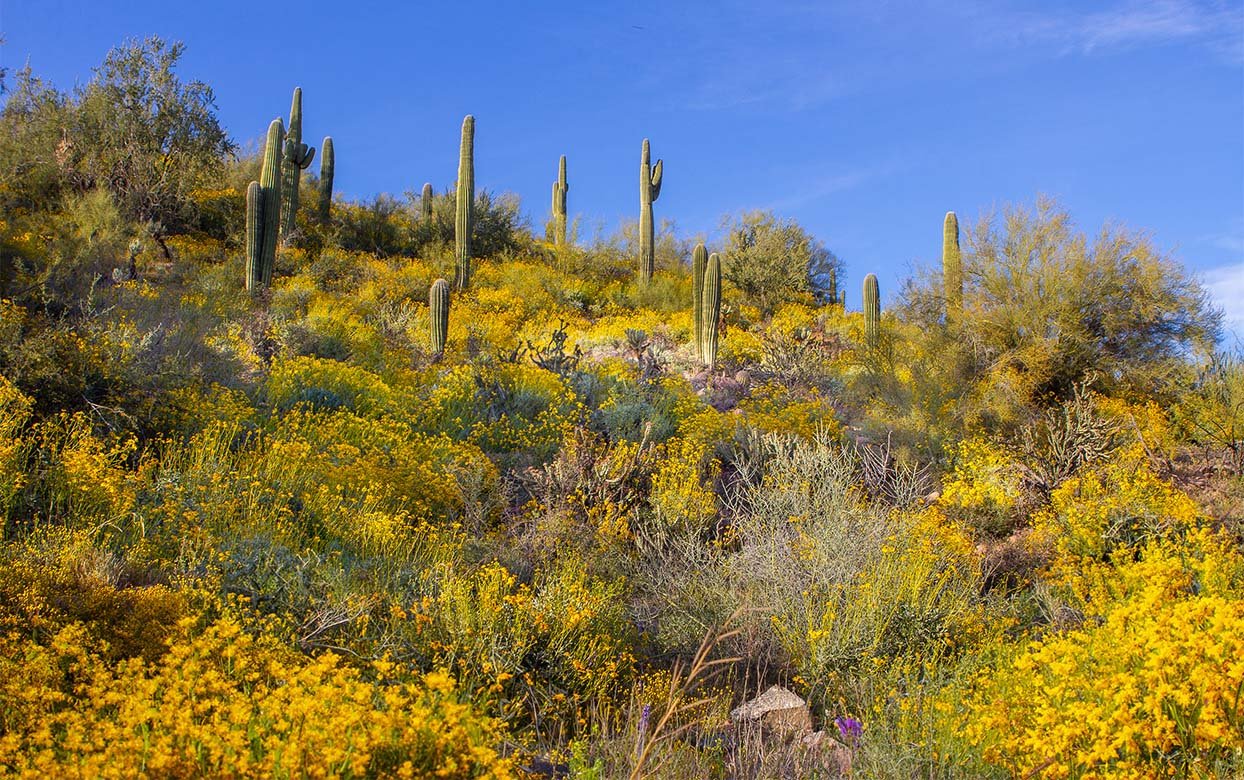
These are the backbone of a low-maintenance desert garden. Saguaro, barrel cactus, prickly pear, and agave are all excellent choices that require almost no supplemental water once established. Plant in well-draining soil and resist the urge to overwater — more cacti die from too much water than too little.
Native Wildflowers
Desert wildflowers like brittlebush, Mexican poppy, penstemon, and desert marigold bring brilliant seasonal color and support native pollinators. Sow seeds in fall for a spectacular spring bloom. Once established, many will self-seed and return year after year.
Drought-Tolerant Shrubs and Trees
Palo verde, desert willow, and mesquite provide shade, structure, and habitat while thriving on minimal water. Plant in fall to give roots time to establish before summer heat arrives. These trees form the canopy layer of a mature desert garden and make the entire space more livable for plants and people alike.
Efficient Watering Techniques
Drip Irrigation Systems
A drip system is the most efficient way to water a desert garden. It delivers water directly to the root zone, eliminates evaporation from overhead spraying, and can be put on a timer so plants are watered early in the morning when temperatures are lowest. Even a basic setup dramatically reduces both your water bill and the time you spend with a hose.
Timing Matters
Water early in the morning to minimize evaporation. Once plants are established, water deeply and infrequently — this trains roots to grow down toward reliable subsoil moisture rather than staying near the surface where they're vulnerable to heat. Shallow, frequent watering creates shallow-rooted plants that struggle through summer.
Common Beginner Questions
How often should I water? Established native plants in the low desert need watering every 1–2 weeks in summer and once a month or less in cooler months. Newly planted specimens need more frequent watering for the first season while roots establish.
How do I manage pests? Desert gardens have fewer pest problems than traditional gardens, but watch for aphids on new growth, scale on cacti, and leaf-cutter ants. Neem oil handles most soft-bodied insects without harming beneficial insects. For ants, treat the colony directly rather than the plants.
Can I grow vegetables in a desert garden? Absolutely. The desert has two vegetable-growing seasons: cool season (October–March) for leafy greens, root vegetables, and brassicas; and warm season (March–May, then again after monsoons) for tomatoes, peppers, squash, and beans. Raised beds with amended soil and consistent drip irrigation make desert vegetable gardening very productive.
Tips for Successful Desert Gardening
- Start with a small area and expand gradually — you'll learn far more from a small, well-tended space than a large one you're struggling to maintain.
- Observe sunlight, drainage, and existing conditions before planting — notice where water pools after rain, which areas get afternoon shade, and what's already growing naturally nearby.
- Approach gardening with patience. Desert gardens develop beautifully over time. The plants that look small and unremarkable in year one become the defining features of your landscape in year three.
Desert gardens develop beautifully over time. Enjoy the nurturing process — the rewards compound with every season.
Ready to plan your planting schedule? Read our guide on the best time of year to plant in the desert and why the timing of when you put plants in the ground matters more here than almost anywhere else.